
What Makes a Good B2B Lead? (2026 Guide)
What Makes a Good B2B Lead? (A No-Nonsense Guide)
The Trap of the Full Spreadsheet
I see this happen all the time. A marketing team runs a massive campaign, captures 2,000 new email addresses, and hands the list over to the sales team. Everyone high-fives. The spreadsheet is packed.
Two weeks later, the sales team hasn't closed a single deal.
Why? Because a list of names is not a list of leads. If you are doing B2B lead generation, filling your database with random interns, out-of-market companies, and people who accidentally downloaded your eBook is a massive waste of time. It burns your salespeople out and throws your conversion metrics completely out of whack.
If you want your outbound campaigns to actually make money, you have to stop obsessing over quantity and start ruthlessly protecting the quality of your pipeline. Let's break down what actually makes a good B2B lead, and how to stop wasting time on the bad ones.
What Exactly is a B2B Lead?
In the simplest terms, a B2B (business-to-business) lead is a person who works at a company that could realistically buy your product or service.
But that is just the baseline. A good lead is someone who checks specific boxes regarding their role, their company size, and their current business pains. If they don't check those boxes, they are just a name on a list.
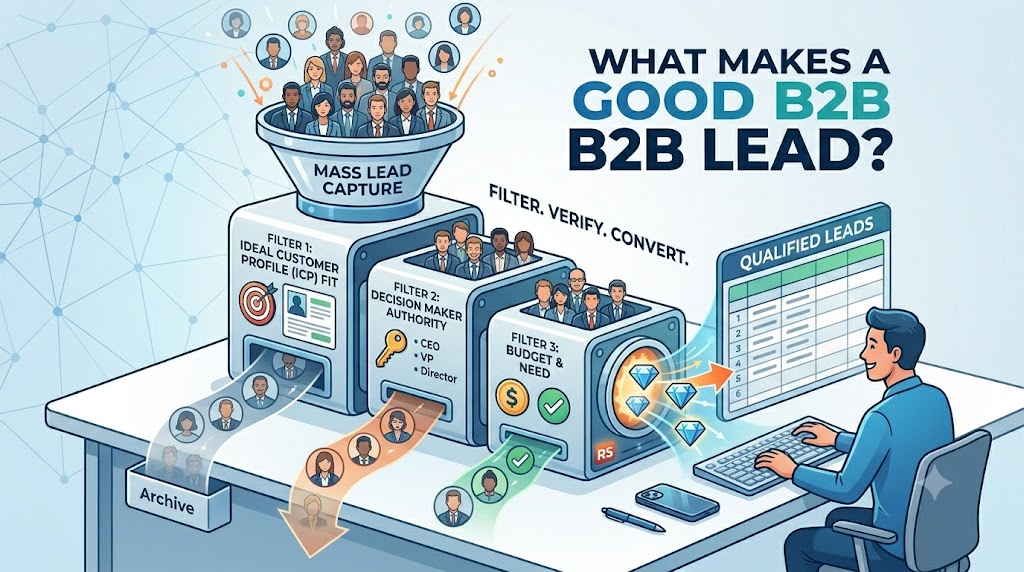
The 3 Pillars of a Truly Good B2B Lead
If you want to know if a lead is worth your time, run them through this quick checklist.
How to Stop Chasing Dead Ends
The biggest mistake beginners make in B2B lead generation is trying to sell to everyone. Here is how you fix that:
Stop buying generic lists
If you buy a list of "10,000 local businesses," 90% of them will be junk. You will spend hours calling people who have zero interest in what you do.
Filter ruthlessly on the front end
Before you send a single cold email or make a single phone call, look at the data. If the job title says "Assistant," skip it. If the company revenue is too small, delete it.
Verify your data
A perfect lead is useless if their email address bounces. Always run your lists through a tool like the RS Email Verifier before you launch a campaign.
Building a Smarter B2B Lead Generation Engine
The secret to high-converting outbound sales is pulling your own data so you control exactly who goes into your pipeline.
Instead of waiting for the right people to magically find your website, go find them. If you know you want to talk to VPs of Marketing at software companies in Texas, use a tool built for the job.
Using software like the RS Lead Extractor Ultimate allows you to scrape directories and websites specifically for those exact parameters. You pull the exact names, business emails, and phone numbers of the decision-makers you actually want to talk to. When you build your lists this way, your sales team spends less time digging through garbage and more time closing deals.
FAQs About B2B Lead Generation
Featured Snippet Answer
A good B2B lead is a prospect who matches your Ideal Customer Profile (ICP), holds decision-making authority within their company, and has a legitimate business problem that your product or service can solve.
Q: What is the difference between a lead and a prospect?
A: A lead is someone who might be a fit for your business but hasn't been heavily vetted yet. A prospect is a lead who has been qualified—you have confirmed they have the budget, authority, and need to actually buy.
Q: How many leads do I need to make a sale?
A: This depends entirely on your data quality. If you are scraping highly targeted, verified decision-makers, you might close 1 in 20. If you are emailing a generic, unverified list, you might close 1 in 1,000. Quality always beats volume.
Q: Should I target lower-level employees to get my foot in the door?
A: You can, and it's called "bottom-up selling." But it is usually a much longer, slower process. It is almost always faster to find business emails for the actual decision-makers and pitch them directly.
Q: What is a qualified lead?
A: A qualified lead is someone who has explicitly shown interest (like replying to your cold email asking for a demo) and meets your criteria for being a good fit.
Final Thoughts
Stop celebrating big spreadsheets full of bad data. A list of 100 perfectly targeted, verified decision-makers is worth ten times more than a list of 5,000 random email addresses you scraped blindly.
Take the time to define exactly who your perfect buyer is. Look at their job title, their company size, and their pain points. Once you know exactly what a good lead looks like for your specific business, use a dedicated extraction tool to go pull that exact data. When you hand your sales team a list of actual buyers, your revenue will reflect it.