
How to Verify Email Addresses & Improve Deliverability (2026 Guide)
 Rajesh
How to Verify Email Addresses to Maximize Deliverability (Complete Guide)

Extracting a highly targeted list of prospect emails is a major win for your outbound sales strategy. However, extracting the email is only step one.
Websites frequently harbor outdated or abandoned email addresses. If you immediately load a raw, scraped list into your sending tool, you are playing a dangerous game with your domain's reputation.
Before sending a single pitch, you must clean your list. In this guide, we will break down exactly how to verify email addresses, why skipping this step can destroy your outreach campaigns, and how to automate list hygiene so your messages always land in the primary inbox.
What is Email Verification?
Email verification is the process of confirming that an email address is valid, active, and capable of receiving messages—without actually sending an email to that address. It filters out typos, temporary addresses, honeypots, and domains that no longer exist.
By verifying your leads, you ensure that you are only communicating with real, active decision-makers.
How Email Verification Actually Works
When you run an email through a verifier, the software performs several rapid-fire checks behind the scenes:
Syntax Check
Ensures the address is formatted correctly (e.g., removing spaces or missing "@" symbols).
Domain/MX Record Check
Confirms that the domain is active and configured to accept mail.
Server Ping (SMTP Check)
The tool briefly communicates with the recipient's mail server to ask if the specific inbox exists, disconnecting before a message is actually sent.
Manual Checking vs. Automated Verification Tools
If you have a list of five contacts, you might try testing formats in Gmail to see if a Google Workspace profile populates. But for any serious lead generation effort, manual methods are entirely unscalable. Using an automated solution is the most effective route.
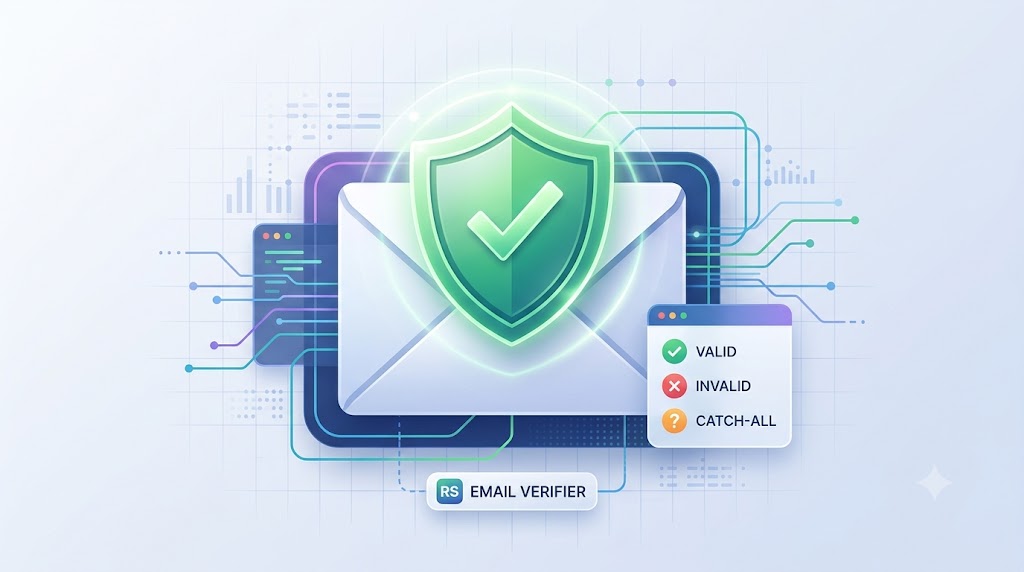
Using a tool like the RS Email Verifier helps verify and clean email lists, reduce bounce rates, and improve email deliverability. Automated software can process thousands of emails in minutes, categorizing them into "Valid," "Invalid," and "Catch-all" so you know exactly which leads are safe to contact.
Best Practices for Maintaining List Hygiene
Verify Immediately Before Sending
Data decays rapidly. People change jobs and companies shut down. Always verify your lists right before launching your campaign, even if you verified them a few months ago.
Segment Catch-All Emails
Some company servers accept all incoming mail regardless of the prefix. Treat these "catch-all" addresses with caution and drip them into your campaigns slowly.
Stay Compliant
Maintaining a clean list also means respecting opt-outs. Always ensure your cold outreach complies with local regulations, such as CAN-SPAM in the US or GDPR in Europe.
FAQs about Email Verification
1. Can I just send a test email to see if it bounces?
No. Intentionally bouncing emails hurts your sender score. A dedicated verification tool checks the server without sending an actual message, protecting your reputation.
2. Does verification guarantee 100% deliverability?
While it guarantees the inbox exists, deliverability also depends on your email content, sender setup (SPF/DKIM/DMARC), and sending volume. However, verification is the foundational step for achieving high deliverability.
3. What is a spam trap or honeypot?
These are fake email addresses created by anti-spam organizations to catch spammers. Scraping without verifying often sweeps these up. A premium verifier will identify and remove known spam traps from your list.
Conclusion
Successful outreach is a two-part process: extracting the data, and ensuring that data is clean. You cannot have one without the other. Protecting your domain is paramount.
By combining a powerful scraping tool with a rigorous verification process, you guarantee that your messages actually land in the inbox. To start cleaning your lists today, try using software built specifically to streamline the entire process, like the RS Email Verifier.